Pages

Ads 468x60px

Labels

Job Site Hazard - The Big Four - Safety Topic


Residential construction safety professionals often use the four basic job site hazard subject areas as a means to get interest from the on-the-job employees; it works out very well as a training or instructional guide.

The big four are:

Falls from Elevated Heights: 
  • Subject areas include falls in general, ladders, floors and other openings on the walking/working surfaces (don’t forget skylight wells), and the need to have guardrails or other fall protection devices installed.
  • We included the need for personal fall protection systems (PFAS) in these Tool Box Talks as discussion points. The various standards of when to wear PFAS will require some research on your part. However, you need to know that when a compliance officer sees someone working on a roof, they are required by statute to check out the situation to see if a worker is exposed to falling.
Being Struck By: 
  • This is a term used by industry safety and insurance personnel. Being struck by includes being hit by a hand or power tool. For example, when you accidentally hit your thumb with a hammer holding down a nail. You were struck by the hammer causing an injury.
  • There are a lot of other more serious examples. One is using a nail gun and accidentally discharging a nail into a foot. Another example is an amputation of a hand or finger by a saw blade because the guard was removed.
  • When we put together this booklet, we looked at specific subject areas to include in “being stuck by.” Because the accidents/incidents are so common, we decided to save paper and include the subjects in such areas as Tool Use and Care and Heavy Equipment subject areas.
Being caught between or under: 
  • This is also a term used by industry safety and insurance workers. The primary example is excavation crews. Like seeing someone working on a roof, compliance officers are required to stop and inspect when they see a hole in the ground. Be advised. A more common example of a worker being injured is during the raising of a framed wall. If the wall falls backwards, a worker is potentially exposed to being “caught between.” In this case, between the wall and the floor. Hips and legs have been broken by falling walls.
Electrical: 
  • This applies to all electrical hazards. One reason why electrical hazards are mentioned though out the tool box talks is because of the exposure all workers have to electrical hazards, the silent killer.

Think safe - work safe - live safe

Think safely in everything you do 

Safety First

Pinch Points - Safety Topic


Each year, workers suffer approximately 125,000 caught or crushed injuries that occur when body parts get caught between two objects or entangled with machinery. These hazards are also referred to as "pinch points". The physical forces applied to a body part caught in a pinch point can vary and cause injuries ranging from bruises, cuts, amputated body parts and even death.

Dress appropriately for work with pants and sleeves that are not too long or too loose. Shirts should be fitted or tucked in. Do not wear any kind of jewelry. Tie back long hair and tuck braids and ponytails behind you or into your clothing. Wear the appropriate, well-fitting gloves for your job.

Look for possible pinch points before you start a task. Take the time to plan out your actions and decide on the necessary steps to work safely. Give your work your full attention. Don't joke around, daydream, or try to multi-task on the job-most accidents occur when workers are distracted. Read and follow warning signs posted on equipment. If you value all that your hands can do, THINK before you put them in a hazardous spot.

If you have ever slammed your finger in a door, you can appreciate the pain associated with this common type of caught/crush injury. Take the time to learn about the caught/crush hazards in your workplace so you don't learn about the consequences firsthand 


Think safely in everything you do 
Safety First


Office Safety - Safety Topic


Many workers think that the office environment is the safest workplace. But, a safe office workplace requires hazard control, good housekeeping, and safe work practices.

  • Arrange your office to allow clear walkways and aisles throughout the rooms and near exits.
  • Attach tall and heavy office furniture to the wall to avoid tipovers in an earthquake.
  • Do not store heavy items or hang pictures over your head in your office or cube.
  • Close file cabinet drawers, file doors, and pull-out work tables when not in use.
  • To avoid jamming your fingers or hands, make sure that cabinet and desk drawers do not open into walls or other furniture. Close drawers and doors with the flat of your hand.
  • Prevent falls in the office by keeping walkways and floors clear of trash, cords, cables, and other items.
  • Clean up work areas after each project and periodically throughout the day.
  • Clean up liquid spills immediately and mark the hazard area with a “wet floor” sign until the floor dries.
  • Walk slowly, and be aware of your surroundings.
  • Use handrails when going up and down stairs.
  • Wear proper footwear at the office; a non-slip sole and a back strap are safest.
  • Store supplies and materials properly to maintain a safe workplace.
  • Arrange your storage so that the heavier items are stored on lower shelves and keep lighter-weight items on upper shelves.
  • Keep a sturdy step stool in storage areas to avoid reaching. Use good body mechanics when lifting and moving items.
  • Request an ergonomic evaluation from your supervisor if you feel discomfort while at your desk or performing other tasks at work.
  • Use only approved electrical equipment in the office.
  • Examine electric cords and plugs for breaks, tears, and frayed wires before use.
  • Do not use extension cords as a permanent source of electrical power; install an extra electric outlet if necessary.
  • Do not create chains of extension cords and surge protectors (“daisy-chains”) because they can overload your electrical outlets and create fire hazards.
Periodic workplace safety inspections can keep your office safe. Report hazards to your supervisor quickly and make sure that they get corrected as soon as possible. Be prepared for an emergency in your building. Know your building emergency procedures, evacuation routes, and assembly area. Know how to use a fire extinguisher and when it is safe to do so. Keep exits and aisle walkways clear to allow a quick evacuation .

Think safely in everything you do 
Safety First

Accidents Are Avoidable - Safety Topic


Each time someone is injured, we need to ask ourselves “how did it happen?” 

Accidents just don’t happen, they are caused. Accidents are usually a result of someone not paying attention or not knowing how to recognize a job safety hazard. Jobs with effective safety attitudes have about a fifth as many injuries compared to those without the safety attitude. Today we will discuss some general rules to follow and the four hazard avoidance rules.

General Rules 
  • Learn the safe way to do your job
  • Don’t jump from one elevation to another.
  • Don’t work under suspended loads
  • Remove protruding nails or bend them over
  • Keep the work area clear of debris
  • Use the personal protective equipment required for the job
  • Treat all electrical wires as being “live.” 
  • Use the right tool for the right job
  • Be sure all tools are in good shape
Four Hazard Avoidance Rules 
  • Know the safe way to work, and then follow the safe way all the time.
  • Maintain safe working conditions – for yourself and others around you
  • Work safely, setting the example, and encourage others to do so
  • Report all accidents and near misses
Remember: 

Remember to ask yourself if you are following the basic common sense rules? 

If you aren’t following them, then take the chance and you will have or cause an accident. 

Keep asking yourself “how can I make my work safer?” 

Doing so and you’ll probably not have a serious accident, and help prevent a serious accident for a fellow worker


Think safely in everything you do 
Safety First


Horseplay – Don’t Do It! - Safety Topic


A Carpenter was injured during a horseplay incident that occurred when employees were returning from their lunch break. He exited his vehicle to approach employees who were engaged in a water fight, and neglected to turn off the ignition and place the vehicle in park.

When the truck started to roll forward, he attempted to enter the vehicle from the passenger side door which was locked. He then ran around the front of the vehicle to the driver’s door.

As he reached the door the vehicle pinned him against a large water tank, breaking his arm. Another employee stopped the vehicle by breaking the passenger window with a rock and turning off the ignition. The vehicle was then pushed back into a position that allowed the pinned employee to be freed.

Our working environment is potentially dangerous and anything that unnecessarily increases the chance of an injury must be eliminated.

Horseplay includes;
  • Scaring someone.
  • Air hosing someone.
  • Wrestling with someone.
  • Boxing.
  • Throwing water on someone.
  • Goosing, pinching, grabbing, back slapping
  • Dropping objects next to someone to startle.
  • Throwing objects or tools at someone.
  • Discharging a fire extinguisher.
Imagine horseplay, which you are involved in, resulting in an injury to a co-worker. It’s easy enough to get hurt on the job under normal conditions. 

Don’t increase the chance of injury by unnecessary distractions; horseplay is a hazard to all fellow employees who are trying to mind their own business and do their jobs well. Worksite foolishness should not be tolerated. Such acts as tripping, pushing, throwing tools or other objects and water fights, have no place on the job. 

Horseplay – Don’t Do It! 


Think safe - work safe - live safe
Think safely in everything you do 
Safety First

Don’t Slip Up - Safety Topic


Slips and falls are a leading cause of workplace injuries. 

What do experts recommend as the single most important step to take in preventing slips and falls? 

Simple...keep floors clean, dry, and free of obstruction. When it comes to safeguards against slips and falls, nothing is more important than good housekeeping.

When you walk through a work area, look for spills, grease spots or dust (flour and machine byproducts can be highly slippery). Water spilled by drinking fountains or tracked in on wet or snowy days can create a major hazard. Look around and be aware of wet areas or objects on the floor. Then take the time to do something about it. Clean up the hazard or place cones or hazard signs nearby, warning of the danger. People can walk on extremely slippery surfaces by modifying their speed and stride, provided they know about the dangerous condition. It’s the lack of warning that can cause problems. An unexpected shift from a smooth to a slick surface heightens the likelihood of a slip or fall.

A Slip…A Trip…A Hospital Trip

Slips, trips and falls are a serious safety concern in the workplace, taking over 700 lives and inflicting over 300,000 serious injuries every year. Don’t become a statistic…The most common kinds of accidents at work are slips, trips and falls. Be safe and look before you leap.

Look for signs of flooring change. Changes in lighting and floor color can conceal a change in friction or angle between adjacent surfaces. Wherever possible, waxes and polishes should cover an entire area, extending to natural breaks in flooring. Choose footwear according to floor surface. Consider slips and falls when you’re doing a job. Some tasks, such as pushing loads, may require special attention to slip-resistant floor surfaces or carefully selected sole material and treads. For some jobs, better lighting or a stable brace is helpful. Carefully placed and mounted hand rails, poles or hip bars may help operators brace themselves. This reduces reliance on foot/floor friction, which thereby reduces the potential for slipping.

Slips can occur because of how you walk on a surface. Some simple things you can do to minimize your chance of slipping and falling would be to wear appropriate footwear; watch where you’re going; take slow, short steps where slip potential is high; and use hand holds where possible.


Think safe - work safe - live safe
Think safely in everything you do 
Safety First


Controlling Stress - Safety Topic


Stresses, 

Many of us are faced with it every day, but we might not know how to deal with it. It is important to learn how to handle stress because it can affect our performance and relationships in our work and home. At work, stress can lead to distraction and cause an unfortunate accident. At home, stress can put a strain on family relationships.

Stress usually occurs when there are changes in our lives and we feel that we don't have enough resources to deal with those changes and demands. 

Which of the following do you think causes stress: getting married, winning the lottery, or having an argument? 

It is all of them. Stress can occur not only from negative life experiences, but also from positive ones. People react and deal with stress differently, but common stress symptoms include upset stomach, fatigue, tight neck muscles, irritability and headaches. Some people react to stress by eating or drinking too much, losing sleep or smoking cigarettes. Stress may also make you more susceptible to illnesses, including the common cold, ulcers, and some cancers.

The first step to managing stress into identify your "stressors"; trothing's that are making you react. Stressors may not only be events that cause you to feel sad, frightened, anxious or happy. You can cause stress through your thoughts, feelings and expectations  

Look at the list below. 

Which cause you stress? Can you think of other stressors?

Not enough time
  • Unexpected change
  • Family problems
  • Extra responsibility
  • Personality clashes
  • Money difficulties

Everyone has to deal with life's problems. A key to dealing with the big and little everyday stressors is coping with stress in a positive way.

1. Acceptance
  • Many of us worry about things we have no control over. For example, a family illness, great deal of change at work, or finding out that your basketball team lost. One way to manage stress is to accept when things are beyond your control. It may be helpful to think positive thoughts such as, "Someday I'll laugh about this," or "It's a learning experience."
2. Attitude
  • Try to focus on the positive side of situations. Ask yourself, "What good can come out of this?" "What can I learn from this situation?" and "How can I handle this better when it comes up again?" Solutions come easier when you focus on the positive and your stress level will be reduced. 
3. Perspective
  • We often worry about things that never happen. Keep things in perspective by asking yourself, "How important is this situation? Can I do anything about it?, In five years, will I even remember it happened?"

Think about situations in your life that cause you stress

Are they important or un important? 

Are they controllable or uncontrollable? 

If they are controllable events, you can take action to change the situation; if they are uncontrollable, you can use your skills in acceptance, attitude and perspective to reduce the stress.

Think safe - work safe - live safe
Think safely in everything you do 
Safety First


Safe Lifting Techniques - Safety Topic


safety-topic.blogspot.com

Can you think of even one job or occupation where you never have to lift an object?  - I can't. 

Lifting of objects can range from very light objects such as a piece of paper, a pin or a pen to very heavy objects like loads of boxes. Lifting is very much a part of our every day jobs. And, because it is something we do so often, we tend to do it without thinking, or at least we do until we strain a muscle, or worse, hurt our backs.

Lifting incorrectly can result in a variety of injuries. Back strain is a very common one. It results from over-stretching certain muscles, but it can be avoided by practicing safe lifting techniques. A hernia is another injury associated with lifting. A hernia does not generally result from a single lifting effort. It is usually the result of continued extreme exertion, especially done contrary to the structure of body.

Don't underestimate the importance of being in good physical condition. Years of poor posture, overeating, lack of exercise, stress and improper lifting can catch up with you. Learn how your back works and what you can do to keep it strong. Ask for your physician's recommended stretching, warm-up, and reconditioning exercises; then practice them regularly.
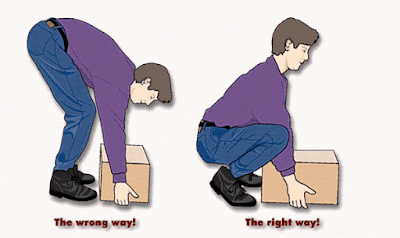
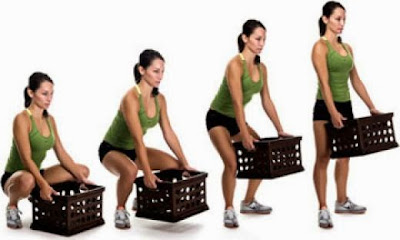
Safe lifting plays an important role in keeping your back healthy. Although there doesn't seem to be just one right method to lift an object, there are lifting techniques that take strain off the low back area.

These techniques have several steps in common. They recommend you "size up the load". That is, look it over. Decide if you can handle it alone or if you need help. When in doubt, ask for help. Moving a box or other object that is too heavy for one person is not worth strained and sore back muscles.

You should also "size up the area". Look over the area where you are carrying the object to, and make sure it is clear of obstacles before beginning to carry the object.

For that period of time spent lifting, the load becomes a part of your body. You support and propel the object while it is attached to you. This attachment should be firm and sure. Get a good grip.
Attaching yourself to a load will change your balance. To keep this change of balance to a minimum, keep the load close to your body, to your normal center of gravity between the legs, between the shoulders.

Good foot position allows you to keep your balance and bring into play the full power of your leg muscles. Leg muscles are more powerful and more durable than back muscles. Let your leg muscles do the work. Again, footwork is important once you avoid twisting your upper body. Use your feet to change direction. Don't twist your body. Twisting compounds the stress of the lift and affects your balance.

When you have someone helping you lift an object, teamwork becomes important. If you're going to be carrying the load to another point, both of you should decide in advance how it is to be handled. Check the route and clearance. One person should be the leader and be in a position to observe and direct the other. Lifting and lowering should be done in unison. Don't let the load drop suddenly without warning your partner.

safety-topic.blogspot.com

Everyone has a way of lifting that seems most natural. Examine yours to see if you are using lifting techniques that reduce strain on your lower back. As the employee making the lift, you're being counted on to make lifts that are safe and comfortable for you based on the items we've discussed:
  • Size up the object – is it too heavy or awkward in shape or size?
  • Consider asking for assistance or using suitable equipment (eg trolley).
  • Consider achieving the “lift” by performing several smaller safe lifts, rather than one unsafe lift.
  • Stand close to the object
  • Keep your arms and elbows close to your body.
  • Bend with your knees don’t stoop.
  • Position your feet shoulder width apart or with one foot ‘beside’  and the other foot ‘behind’ the object.
  • Maintain a “long” spine. (Think about a line that goes from your head through your spine all the way down to your tail bone)
  • Tighten your abdominal core stability muscles.
  • Use your thigh and buttock muscles to lift the load
  • Don’t twist while carrying the object. To change direction, shift your foot position and turn your entire body.
  • Avoid lifting after prolong sitting  or forward bending (eg  long drives or weeding the garden).
Check out a You Tube Video of safe lifting on the link below:


Think safe - work safe - live safe
Think safely in everything you do 
Safety First


Prevent Accidents - Safety Topic


Have you ever wondered what you can do to prevent accidents? 

Remember accidents don’t just happen. They are caused eliminate the cause you eliminate the accident.  

SOMETHING TO THINK ABOUT 

Here's something to think about. Statistics show that in many cases an accident could have been prevented by the victim. And, in other cases, by a co-worker.  In other words, that person or someone else working on the job could have prevented it.  

SEVEN SUGGESTIONS

  1. Make accident prevention a part of your daily routine: Plan safety in advance. Before beginning a job, be sure your tools are in good condition. Also, see that you have the required protective equipment.” Let safety be a habit”  
  2. Report unsafe acts or conditions to your supervisor: If you see something that's dangerous or someone working in an unsafe way, do something about it. If it's an unsafe condition, correct it if you can. Otherwise, report it to someone who has the authority or ability to do so. If you see someone committing an unsafe act, warn that person in a friendly way.   
  3. Avoid horseplay: Aren't you always telling your kids to knock it off before someone gets hurt? Well, horse- play is dangerous for kids of any age. On a job you can easily be injured if you're not strictly business all of the time. Often a person is killed or hurt when a "harmless" prank or a practical joke backfires.   
  4. Follow instructions: You'd follow instructions if you were dismantling a time bomb - and very carefully at that. Well, take the same attitude on the job. When we give you instructions, it's only after we've considered the safest and best way to do it. Sometimes doing something just a little different from what you were told can get you or someone else in a lot of trouble. 
  5. Make suggestions: If you see a better way to do something, let someone know. Check it out and if it's practical, use it. But first make sure it's safe.   
  6. Practice good housekeeping: Nobody likes a slob .its upsetting to see someone with a messy work area. And it goes even further than that. A sloppy work area is not only hard on the eyes, but a breeding ground for accidents. Trash and materials strewn around can result in trips, falls, and fires.   
  7. Dress for the job: In addition to wearing protective equipment, dress so that you won't get hurt. Don't wear floppy clothing (such as loose sleeves or cuffs) or jewelry that can catch on something or become entangled in machinery. 

Think safe - work safe - live safe
Think safely in everything you do 
Safety First

Protect Your Hearing - Safety Topic


WHAT IS AT STAKE
  • Noise (Encarta Dictionary definition:  A loud, surprising, irritating, or unwanted sound) can cause permanent damage to your hearing.  Therefore, it is important to protect yourself against noise hazards.  
WHAT IS THE DANGER
  • Noise-induced hearing loss, either partial or full, that hearing aids, medicine, or surgery cannot reverse nor wholly restore.  
EXAMPLES
  • A sudden single loud sound of an explosion, jet engine or air tool can damage hearing.  However, hearing loss usually occurs from lower doses of noise over time, with damage building up.
HOW TO PROTECT YOURSELF
  • Your employer is responsible for figuring out the right hearing protection equipment for you to use, and keeping the workplace as free as possible from noise hazards.  If you have suggestions, pass them to your supervisor. 
PROTECT YOUR HEARING
  • Reduce the noise reaching your ears.  Nothing can totally block sound, but some hearing protection devices can block out part of the noise.
  • Electronic hearing protection devices permit conversations and warnings to reach the ear, but prevent harmful sound-pressure levels.  Other electronic hearing protectors pick up and amplify desirable sounds.  Some earmuffs or earplugs combine with communication systems for use in noisy areas.
  • Earmuffs – filled with liquid or foam – come in various styles for function and comfort.  Earmuffs are fitted with a headband made of metal or plastic.  Some headbands can be folded or put around the front or back of the neck in various positions.  Cooling pads are even available for earmuffs worn in hot work environments.
  • Earplugs can be pre-molded to fit all wearers, or custom molded to fit exactly.  They can be made expandable or non-expandable, and may be either reusable or disposable.  Earplugs are available on cords you can wear around your neck so you can use them easily.
  • Cooperate with your workplace’s hearing protection program.  Wear recommended personal protective equipment and take good care of it by cleaning it according to the manufacturer’s recommendation and placing it as needed.  

HEARING DAMAGE/LOSS CAN BE PREVENTED.  
TAKE HEARING PRECAUTION SERIOUSLY!


Think safe - work safe - live safe
Think safely in everything you do 
Safety First


Good Hygiene on the Job - Safety Topic


When working with chemicals or other hazardous substances, the word “hygiene” takes on a meaning beyond smelling good and looking nice.  The goal of good hygiene on the job is to prevent accidental exposures caused by inhaling or ingesting hazardous substances.  By practicing good hygiene, exposures caused by accidental cross-contamination can be prevented.  

Smoke, eat and drink only in designated areas; not in areas where hazardous materials are used or stored.  Small amounts of the substances may be present in the area and smoking, eating and drinking nearby could cause you to inhale or ingest the hazardous material.  Wash up before smoking, eating or drinking if you have been working with hazardous materials.

Read the MSDS before you use the substance.  If a hazardous material is splashed in your eyes or on your skin or clothing, wash promptly, even if you have no apparent symptoms.  The SDS will provide information about what to do in case of contact.  

Remove contact lenses when working in an area where vapors are present.  Contact lenses absorb substances from the air, causing eye irritation and other potentially serious conditions.

Keep work clothes clean and in good condition.  Holes or tears can allow hazardous materials to get on your skin, increasing the likelihood of exposure.  Do not mix contaminated clothing with clothing that is not contaminated.

Keep hazardous material storage areas clean.  In case of a spill, the area should be cleaned according to proper spill control and clean-up procedures.  Materials used to clean up the spill must also be disposed of properly.

These practices help keep hazardous substances away from your skin and eyes and out of your body. None of them are difficult to do. Perhaps the hardest thing about practicing good industrial hygiene on the job is overcoming bad hygiene habits. After all, most people usually don’t notice an adverse health symptom immediately after they eat or smoke in an area that is contaminated with hazardous substances. Generally speaking, adverse health symptoms occur after long-term, repeated exposure to hazardous substances. If you are aware of any bad hygiene habits that you practice, the key to changing them is to remember that the only thing that you gain from practicing poor industrial hygiene is poor health.
Safety First


Think safe - work safe - live safe
Think safely in everything you do 
Safety First

Don't Fall Down On Safety - Safety Topic


A fall might not seem like the most serious kind of accident. Often, it is not. However, did you know the number one workplace killer is slips and falls? 

Here are some ways to prevent this common but sometimes deadly kind of accident:

  • Conduct regular safety inspections of your work area to identify and remove slipping and tripping hazards.
  • Keep your work area and traffic areas free of tripping hazards such as stored materials, scrap, cables, cords and unnecessary equipment or tools. Tool boxes are common tripping hazards, so keep them out of the way.
  • Close drawers and cabinet doors to prevent someone from falling over them.
  • Promptly clean up all spills. Rainwater in a doorway, coffee on a hall floor and oil leaking from machinery are all common slipping hazards. Help keep the floors dry in lunchrooms and washrooms, too.
  • Watch where you are going. Don't try to walk while reading something or carrying an object you can't see over.
  • Don't walk backwards. Many tripping accidents occur when a person backs up and trips over something.
  • Take your time; don't run or rush. It is especially important to slow down on wet floors, icy pavement and sloped surfaces.
  • Wear footwear that helps you to stay on your feet. Shoes should be well-fitting with low heels. Soles should be made of a non-slip material for most work situations. Footwear with treads or cleats may be called for in some jobs.
  • Make sure the lighting is good in your work and traffic areas. Many accidents involving falls occur in dark storerooms and dim hallways.
  • Have your vision checked regularly and change your prescription eyewear as required. 

Check your work area and your work habits frequently to make sure you are doing all you can to prevent slips, trips and falls.

Think safe - work safe - live safe
Think safely in everything you do 
Safety First


Slips Trips and Falls - Safety Topic


From Heavy Vehicle Cab Steps

The cab steps are used hundreds of times per week, and most of the time the drivers negotiate them without difficulties. The need for concentration in order to negotiate the steps safely is sometimes ignored and an injury occurs. The variation in height is most likely to catch out a person climbing or descending the steps and sometimes the cab door can get in the way of the steps if they have to descend in a limited space where the door is not fully opened. Some drivers have been seen to jump from the cab rather than using the steps or descend facing forward, failing to use the three points of contact rule.


From access to and from catwalks on Heavy Vehicles Surfaces placed at different levels can catch out the unwary and one problem with the catwalk area is fuel contamination. The fuel tank of heavy vehicles is commonly situated in the vicinity of the catwalk, and in some cases the tank forms part of the access to the catwalk area with steps built into it. The access in this area commonly becomes contaminated with fuel which can result in drivers slipping, or at the least their footwear becoming contaminated.

In Office Locations

Poor Housekeeping is often a factor in office location trips, where a cable is run across the floor or clutter becomes such that floor space is compromised, wet floor surface from a spillage or from mopping. In all cases, taking the time to concentrate and watch where you are going will keep you free of slip trip and fall risk.
Wearing the right footwear for the environment will help too, ankle support for the uneven surfaces and sturdy soles for protection while walking on the loose rock surfaces


BEING SAFE IS EASY WHEN YOU THINK ABOUT IT! 


Think safe - work safe - live safe
Think safely in everything you do 
Safety First


BBQ Safety - Safety Topic


Grilling food is a popular activity in Theater.  Burns are a common type of barbecue-related injury. Common sense is the best way to prevent them.

 Follow these grilling safety tips:

  • Use a charcoal starter chimney or tube, which starts a charcoal fire by burning paper rather than lighter fluid. 
  • Do not over feed your charcoal fire with starter fluid.  It will flare up when it is lit.
  • Do not spray charcoal lighter fluid on an open flame or hot coals. 
  • Do not smoke while handling the lighter fluid.
  • Avoid big fires. Burn just enough fuel to cook the food. 
  • Place the grill away from the living container. 
  • Use hot pads or insulated gloves when touching hot metal. 
  • Ensure the fire is extinguished when the cooking is finished.
  • Keep the barbecue covered when not in use. Make sure it's cool before being covered.                                                                                  

FOOD + FRIENDS + SAFETY = GOOD TIMES!

Think safe - work safe - live safe
Think safely in everything you do 
Safety First


Was it an accident or was it an error - Safety Topic


What is an accident? 

Briefly, it is a sudden and unforeseen event. Given that definition, can we say that the Apollo fire that killed three astronauts on the launch pad, and the Challenger disaster, were accidents?

The first Apollo fatalities were due to a fire that occurred when the spacecraft cabin was charged with pure oxygen during a test. Unfortunately, there was an electrical short under the seat of one of the astronauts. Oxygen fed the resulting fire. The men could not escape because of a poorly designed escape hatch that took too long to open even under ideal conditions. It is well known that pure oxygen atmospheres are very dangerous. It has also been recognized for many years that escape hatches must be simple to use and designed so they will open quickly.

The Challenger exploded because cold temperatures effected the performance of a seal already stressed due to an inadequate design. Previous Challenger inspections had shown that the seals were not holding up as intended during launches, and it was known that low temperatures would degrade them further.

What do these events have in common? 

In every case, there were experts in charge and plenty of opportunities to anticipate problems. Experience should have told them to take corrective action long before the disastrous incidents took place. So why--in spite of all the warning signs--were these conditions allowed to exist? The answer is simple: The warning signs were overlooked. 

So ask the question again:

 "Were they accidents or were they errors?"

Be alert to warnings and take heed when they are encountered. Irritated by the metal filings hitting you in the face and eyes while you grind? This is a warning that you need eye and face protection. 

Do you keep banging your knuckles when your wrench slips? That is your warning that an old favorite tool may be worn out and need replacing. Have you or a co-worker ever suffered an injury because you failed to anticipate and ward off possible dangers?

Think about what could go wrong before you act! If something minor goes wrong, this is a warning to stop! Consider what has gone awry. Figure out what should be done to resolve the problem, then take care of it! Accidents are usually errors on someone's part. They are not an incidental part of the job. If you accept the mind set that they are, accidents will occur.

This is your challenge: Think about what pitfalls may come up during work tasks. Recognize the early warning signs of things going wrong. Have the strength to stand up and say:

"Hold on a minute. Let's think about this!" 

Think safe - work safe - live safe
Think safely in everything you do 
Safety First


Common-sense safety in the Shop - Safety Topic


Movement in the shop must be considered. When entering the shop each morning or after being away for an extended period of time, check to see if the arrangement of the shop has been changed. This will help in predicting and avoiding accidents caused by bumping into objects. When moving within the shop, attempt to avoid an area where a coworker is operating a machine. Should this be impossible, be sure to let the person know of your presence by addressing them at a time when they are pausing and not working with a machine.

Before working on a machine:
  • Put on proper eye protection (safety glasses, goggles, or full face shield).
  • Put on proper ear protection when operating any of the machines.
  • Wear a dust mask or appropriate respirator when sanding, grinding, or sawing.
  • Check to see if the machine is turned off before plugging it in.
  • Check the condition of the machine. Are there any chips on the working surface or in any of the tracks?
  • Check the guard on the machine by moving it the full range of motion. If it sticks, lubricate it as necessary.
  • Check blades. Replace them if they seem dull.
  • Lift any heavy object carefully with proper technique.
  • Check to be sure the operator and everyone in the vicinity is clear of the area in back of the machine. The blades could catch a piece of wood and throw it from the machine.
Table Saw
  • Always check the track to be sure it is clear of sawdust.
  • When cutting a piece smaller than 10 inches use a push stick and not your hand.
  • Keep stock firm against the fence.
Radial Arm Saw
  • The radial arm saw has a height adjuster, which may be used when the machine is running. Use care when reaching for the height adjuster. Make sure clothing cannot get caught in the blade. There is an automatic power brake that, after use, should apply itself to stop the blade from spinning to rest. Occasionally check to make sure it is in working order. Remember to always return cutter to rear of track.
Power Planer
  • The power planer's chip chute may fill up quickly. It is critical when planing that too much of the wood is not planed off at one time. Any planing deeper than 1/8 inch may cause strain and possible loss of balance.
Power Miter Saw
  • There is a high incidence of injury for those who use a 'chopsaw.' Do not hurry when cutting; keep downward motion smooth; and don't 'push' the blade through the wood, as this is unnecessary for effective cutting. Take time to check the area for any obstructions. The placement of the guide hand must not be overlooked. Along with a power brake, this saw has a 'dead man' switch positioned just before the trigger which, when, depressed shuts off the saw. 
Think safe - work safe - live safe
Think safely in everything you do 
Safety First

Why Take a Chance? - Safety Topic


Are you willing to risk losing your ability to see? Thousands of people take that chance every day by not wearing needed eye protection. In fact 3 out of 5 workers who experienced an eye injury were not wearing their eye protection.

A survey by the Bureau of Labor Statistics (BLS) found that nearly 70% of the injuries were the result of flying or falling objects. Most of the material striking the eye was reportedly moving at speeds faster than something being thrown by hand.

What can you do so you are not added to these statistics?

  • WEAR PROPER EYE PROTECTION AT ALL TIMES. It is estimated that 90% of eye injuries can be prevented through the use of proper protective eyewear. Manufacturers of eye and face protection have greatly improved their products to help encourage more willing and more consistent use. Considerable advancements have been made in the design of this protection to improve the comfort, durability and fashion.
  • MAKE SURE THE EYE PROTECTION IS RIGHT FOR THE HAZARD and that it fits correctly. Also know when to wear goggles and/or a face shield especially when doing high hazard work such as grinding, chipping or working with corrosive compounds. 


According to the University of Washington Ophthalmologists, Inc., most eye injuries are rated either mild or severe, with few being in between. Mild cases usually require only simple outpatient care such as irrigating and antibiotic treatment. Severe cases may require multiple surgeries and in most cases the eye sight will not be as it was before the accident… if vision can be saved at all.

Protecting your eyesight should be one of your greatest concerns whether you are on the job or not. Your company may provide you with eye protection and have a 100% eye protection policy; however, it is your individual responsibility to wear the eye protection. Without your commitment, you put yourself at risk of losing your eyesight.
Often people will think nothing of spending a hundred dollars or more for a pair of name brand fashion sunglasses. Some of the best safety glasses cost less than $10. Fashion eyewear looks great and protects your eyes from the sun. But they are typically not safety-rated, and not designed to protect your eyes from objects impacting the lenses.

Remember! There are no good excuses for not protecting your eyesight.


Think safe - work safe - live safe
Think safely in everything you do 
Safety First


Common Safety Mistakes - Safety Topic


Some of the most dangerous situations arise out of common mistakes that can be easily avoided. This Toolbox Talks document will focus on some of the more common (and commonly overlooked) safety issues that should be prevented to help improve safety performance.

Common Safety Mistakes:

  • Lack of housekeeping: It may seem simple, but a messy / dirty work area makes for an unsafe work environment. Pallet banding lying on the ground spilled oil and obstructed walkways all result in thousands of injuries each year.
  • Not using Lockout / Tagout on equipment needing repair: Thousands of injuries arecaused each year by the failure to lockout or tagout equipment and machinery needing repair. Often times someone knew ahead of time that the equipment was not functioning properly. It is imperative to disable the equipment as soon as someone knows it is not functioning properly. This will ensure the equipment does not cause injury or an unsafe work environment.
  • Improper use of Personal Protective Equipment (PPE): It is a common, yet incorrect, practice to wear hard hats backwards, or to put hearing protection in improperly. A walk around the shop might find face shields that are scratched to the point where visibility is poor. All of these are examples of failures in the proper use of Personal Protective Equipment. PPE is the last line of defense in protecting the employee. Therefore, the improper use of PPE, or failure to maintain and replace defective PPE, increases the likelihood of injury.
  • Not having a process or plan: Most workplace injuries occur when work being done is not part of a normal process. It is important to have a work plan for non-process work. Sometimes such a plan is called a Task Specific Safety Plan. No matter how it is done, planning the work and asking “What if…?” questions will help identify hazards and implement controls to prevent injuries.
  • Failure to communicate: One of the easiest things to prevent unsafe conditions is to discuss what hazards or unsafe acts have been noticed. Communicating the hazards and failures in processes is an essential element of


Think safe - work safe - live safe
Think safely in everything you do 
Safety First


Ladder Safety - Safety Topic


A ladder is an essential workplace tool for anyone working above ground level. However, each year more than half a million people are injured while using ladders.
Anyone who uses the wrong ladder for a job or uses it inappropriately is courting trouble. 

Don’t become a statistic. 

Remember these ladder safety tips:

  • Select the correct ladder. Why waver on the top rung of a stepladder when you can use an extension ladder? Never use a metal ladder if there’’ any chance of contacting electricity.
  • Never assume a ladder is safe. Check it for unsafe footing, broken steps, bent legs, bent supports, cracks, worn or slippery step treads, and worn or missing rubber feet. Don’t use t if there’s a problem.
  • Set the ladder up on flooring that is dry, even and clear of obstacles. Never lean the ladder against anything unstable (such as a stack of boxes) or place it in front of an unguarded or unlocked door.
  • Follow the belt buckle rule when using a stepladder, making sure your belt buckle goes no higher than the top step of the ladder. Climb the ladder only after ensuring the frame is locked securely in place.
  • Follow the four-to-one rule when setting up an extension ladder. Place the ladder with its base one foot away from the wall for every four feet in height. Secure the ladder to a stable object at the top and then lock the extension securely in place. Never stand on the top two steps of an extension ladder.
  • Ask a spotter to hold the base of the ladder while you climb and be especially careful when climbing a ladder on a windy day. Remember to fasten the top of the ladder securely to prevent it from tipping.
  • Ascend and descend the ladder facing the rungs with both hands on the edges. Hoist tools and materials only after you have reached the top of the ladder.
  • Take precautions to prevent a fall. Use both hands when climbing and lock a leg around a rung when you need to have one hand free. Never climb onto a ladder that’s already supporting one person.


Think safe - work safe - live safe
Think safely in everything you do 
Safety First


Hand safety - Safety Topic


How important are your hands?

One of the most complex parts of your body are your hands. Without your hands, routine simple tasks such as opening doors, using a fork, tying shoes, or even putting on clothes would be extremely difficult. 
Because of the complexity of the hand, injuries are difficult to repair Often, after an injury, the hand may not function as it did before the injury. There may be loss of motion, dexterity, grip, and the ability to complete the simplest of tasks. In fact, it may affect your ability to earn a living.

Hand injuries can be associated when working with machinery or equipment. Hand tools or powered hand tools may be faulty or improperly used. However, the most common causes of hand injuries are carelessness, lack of awareness including boredom, disregard for safety procedures, and being distracted from the job task.

To avoid hand injuries, know the hazards and dangers associated with the task. Be aware of pinch points on machinery found between moving parts or objects and stationary parts or objects. Be aware of hot areas that could cause burns. Be aware of rotating or moving surfaces such as drills, saw blades, milling cutters and conveyors. Automated machinery may be remotely controlled or delayed timing devices may cause a machine to start automatically. Loose clothing and jewelry may be caught up in moving machinery. Never remove machine safeguards, and do not operate machinery with its safeguards removed.

The improper use or misuse of hand tools cause minor to serious hand injuries. When the wrong tool is used or the right tool used improperly, hand injuries are likely to happen. When using knives, keep the blade well sharpened. Cut away from your body. Control the process or do not be a part of the process.

Other helpful reminders:
  • Be careful of slippery handles and door jams.
  • Losing control of heavy objects may cause mashed fingers or hands.
  • Protective gloves should be used when the job requires it. Use the proper gloves when working with rough surfaces. Use rubber or polymer gloves when working with chemicals. When chemical contact is made with bare hands, immediately wash or rinse the hands thoroughly or seek medical attention.
  • Avoid using or wearing gloves when working on or with rotating objects or machinery. 


Think safe - work safe - live safe
Think safely in everything you do 
Safety First


Popular Posts

 
Blogger Templates